
If your GPA is lower than you want it to be, the worst advice you can get is "just study harder."
Studying harder, spread evenly across every class, is how students who are already behind stay behind. You burn the same energy on a 3% homework set as you do on a 40% final, run out of time, and watch your grades barely move. The frustrating part is that the effort is real — it's just pointed in the wrong direction.
Raising a GPA when you're behind is not a motivation problem. It's a math problem. Every class has a formula, every assignment has a weight, and once you can see those numbers, the path gets specific: these classes, these assignments, these scores. The real answer to how to improve your GPA in college isn't more hours — it's putting your hours where the grade weight is. This guide shows you how to find that path, and how to stop wasting effort on work that barely moves your grade.
Quick answer: To improve your GPA when you're behind, calculate your current weighted grade in each class, then work out the exact score you need on your remaining assignments to hit your target. Prioritize the classes where a high-weight item (a final worth 30–40% of your grade, a major paper, a project) is still ahead of you — that's where your grade can still move the most. PassAI does this math automatically: enter your scores and target grade, and it shows what you need on every remaining assignment so you can put your hours where they actually count. Free to start at passai.pro.
Why "Study Harder" Doesn't Move Your GPA
Your GPA isn't a measure of effort. It's a weighted average of your grades, and each of those grades is itself a weighted average of your assignments. That second layer is where most students lose ground without realizing it.
Here's the problem in one sentence: not every assignment moves your grade equally, but most students treat them like they do. A weekly quiz worth 3% and a final exam worth 40% feel similar in the moment — both are "things due soon that I should study for." But they are not remotely the same in grade terms. Acing every quiz in a class while bombing the final can still leave you with a C. Nailing the final after mediocre quizzes can pull you to a B.
When you're behind, this gap is the whole game. You don't have unlimited hours. Every hour you spend has to come from somewhere. If you spend them proportional to urgency (what's due next) instead of impact (what's worth the most), you'll work hard and still slide.
There's a second trap, too: chasing grades that are already locked in. The midterm you scored a 72 on is done. No amount of studying changes it. The only grades you can still influence are the ones that haven't been recorded yet. A lot of GPA anxiety is spent re-living past scores instead of acting on the ones still in front of you.
So before anything else, two principles:
- You can only improve the grades that haven't happened yet. Focus entirely on ungraded work.
- Effort should follow grade weight, not due dates. The biggest ungraded items are where your GPA actually moves.
Everything below is built on those two ideas.
Step 1: Find Your Real Current Grade in Every Class
You can't plan a recovery without knowing exactly where you stand — and "I think I have a B-ish in that class" is not knowing.
Your real current grade is the weighted average of everything graded so far. If your Biology class is 20% midterm, 15% labs, 10% quizzes, 15% homework, and a 40% final you haven't taken, then your current grade is calculated only from the 60% that's been graded — not out of 100. That split isn't arbitrary. A heavy final paired with a midterm is one of the most common grade-weight structures we see across the syllabi students upload to PassAI. This is the number students most often get wrong. They average their scores as if everything counts equally, get a misleading figure, and plan around the wrong target.

Take the Biology example above. The graded items earn:
The weighted math
Midterm 78% × 20% + Labs 85% × 15% + Quizzes 70% × 10% + Homework 88% × 15% = 48.6 points out of the 60% that's been graded. Divide by that 60% and your current grade is about 81% — a B−. The 40% final is still entirely ahead of you.
That last sentence is the good news hiding in the math: 40% of your grade is still unwritten. That's an enormous amount of room to move — far more than most students behind in a class assume they have. The first step out of the hole is just seeing it clearly.
Doing this by hand for five classes, each with 15–30 graded items, is exactly the kind of tedious work that gets skipped. The faster path is to upload your syllabus to an AI tool that already knows the weights, then enter your scores as they come back. PassAI keeps a running, accurate current grade for every class so you never have to reconstruct it from scratch.
Step 2: Calculate Exactly What You Need on What's Left
This is the single most useful number for anyone trying to raise a grade, and almost no one calculates it: the score you need on your remaining work to finish at your target.
Back to Biology. You're at 81% (a B−) with a 40% final still ahead, and you want to finish with a B (83%). The math works backward from the target:
What you need on the final
You've banked 48.6 points. To reach 83 overall, you need 34.4 more points from the 40%-weight final: 34.4 ÷ 40 = 86% on the final to finish with a B. Want an A− (90%)? That would take a 104% — which means it's off the table, and now you know not to spend hours chasing it.
That second number matters as much as the first. Knowing a target is impossible is just as valuable as knowing it's within reach, because it tells you where not to spend your limited time. A student who knows the A− is gone redirects those hours to a class where an A is still live. That's the difference between effort and strategy.

Run this calculation for every class and you get something most struggling students never have: a clear, honest map of where your GPA can actually move. PassAI's grade calculator does exactly this. You set a target for each class, and it shows the score you need on every remaining assignment. It also flags the targets that are no longer reachable, so you stop burning time on them.
Step 3: Rank Your Classes by Where the Grade Can Still Move
Once you know what you need in each class, you can rank them — not by how stressed each one makes you feel, but by where improvement is both possible and high-impact.
Sort your classes into three buckets:
High-leverage classes
A large, gradeable item is still ahead (final, major paper, project) and your target is reachable. This is where your hours produce the biggest GPA gain. Spend most of your time here.
Maintenance classes
You're already at or near your target. Don't over-invest — do enough to hold the grade, and move the saved hours to bucket 1.
Locked classes
The grade is essentially decided — either you've secured your target or it's mathematically out of reach. Do the minimum to protect it, and stop spending emotional energy here.
This ranking is what turns the math into a plan. When you sit down to study on a Tuesday night with three hours, you're not choosing based on which class is nagging at you the most. You're choosing the high-leverage class, because that's where those three hours change your transcript.
If you want a structured way to turn this ranking into weekly time blocks, our guide on how to make a study schedule walks through building one around grade weights instead of due dates — the natural next step once you know where your grade can move.
Step 4: Protect Easy Points and Stop the Bleeding
The math points your big effort at high-weight finals and papers. But there's a second front in a GPA recovery that's quieter and just as important: the small points you're leaking.
Late penalties, skipped participation, zeros on low-weight homework — individually they look trivial, which is exactly why they pile up. A handful of zeros on 2% assignments can quietly cost you a full letter grade across a semester. Yet unlike a hard final, they cost you nothing but attention to fix. Submitting every assignment on time, even imperfectly, is often the highest return-on-effort move available to a student who's behind.
The cheapest GPA points you'll ever get
A 70% on a homework set you'd otherwise skip beats a 0 every time. Turning in low-weight work on time is the lowest-effort, highest-certainty way to stop your grade from bleeding while you focus real study time on the high-weight items.
The hard part isn't doing this work — it's not forgetting it exists. When you're behind in five classes, low-weight assignments are exactly the things that slip through. This is where a system beats willpower. PassAI sends a daily email of what's due and what's coming, so the easy points stop disappearing simply because they fell off your radar. Recovering a GPA is as much about plugging leaks as it is about big wins.
Step 5: Talk to Your Professors — With the Numbers in Hand
Most students who are behind avoid their professors out of embarrassment. This is backwards. Professors can offer extra credit, reweighting, regrade requests, a retake, or simply guidance on where to focus — but only if you ask, and only if you ask specifically.
"I'm worried about my grade" gets you sympathy. "I'm at an 81% in the class, I need an 86% on the final to finish with a B, and I want to make sure I'm studying the right material — can you point me to what to prioritize?" gets you a real conversation. The second version works because you've done the math. You're not asking the professor to rescue you; you're showing them you understand exactly where you stand and you're acting on it.
This is the underrated benefit of knowing your numbers cold: it changes how everyone treats your situation, including you. A vague fear becomes a concrete plan, and concrete plans are something a professor can actually help with — and that plan takes thirty seconds to pull up when a tool is already tracking the class for you.
Step 6: Use Your Institutional Levers — Most Students Don't Know They Exist
The steps above are about earning your way back up. But when you're behind, your school often hands you levers that change the GPA math directly — and most students never learn they're there until it's too late to use them.
Grade replacement / repeat policies
Many colleges let you retake a class and have the new grade replace the old one in your GPA, not just average with it. If one bad grade is dragging your cumulative GPA down, retaking that single course can move the number more than a whole semester of new classes. Check your registrar's grade-replacement policy — the rules on how many times you can use it, and which grades qualify, vary by school.
The withdrawal deadline
Sometimes a class is mathematically lost: your grade calculator shows that even a perfect final leaves you below passing. In that case, withdrawing before the deadline usually records a "W" that doesn't factor into your GPA at all. A W is almost always better for your GPA than a D or F. This only works if you act before your school's drop deadline, which is exactly why running the math early matters.
Academic standing thresholds
Most schools place students below a 2.0 cumulative GPA on academic probation, and your specific target should account for where that line sits. If you're near it, talk to an academic advisor early — they can often connect you to tutoring, reduced course loads, or grade-forgiveness programs you'd never find on your own.
It helps to know the target you're aiming at. The average GPA at four-year U.S. colleges has risen to roughly a 3.1 over the past two decades, according to long-running grade-inflation research. And among employers who screen applicants by GPA, a 3.0 cutoff is the most common bar. That said, NACE's research shows fewer employers screen by GPA than students assume. The translation: you have more room than the panic suggests. The levers above are how you protect the number while you climb.
How PassAI Turns This Into a System
Everything in this guide comes down to one repeated action: knowing your real numbers and acting on them. The barrier is that doing it by hand — tracking weights, recomputing current grades, working out what you need on every remaining item, across five classes, every week — is tedious enough that almost no one keeps it up. That's the gap PassAI is built to close.
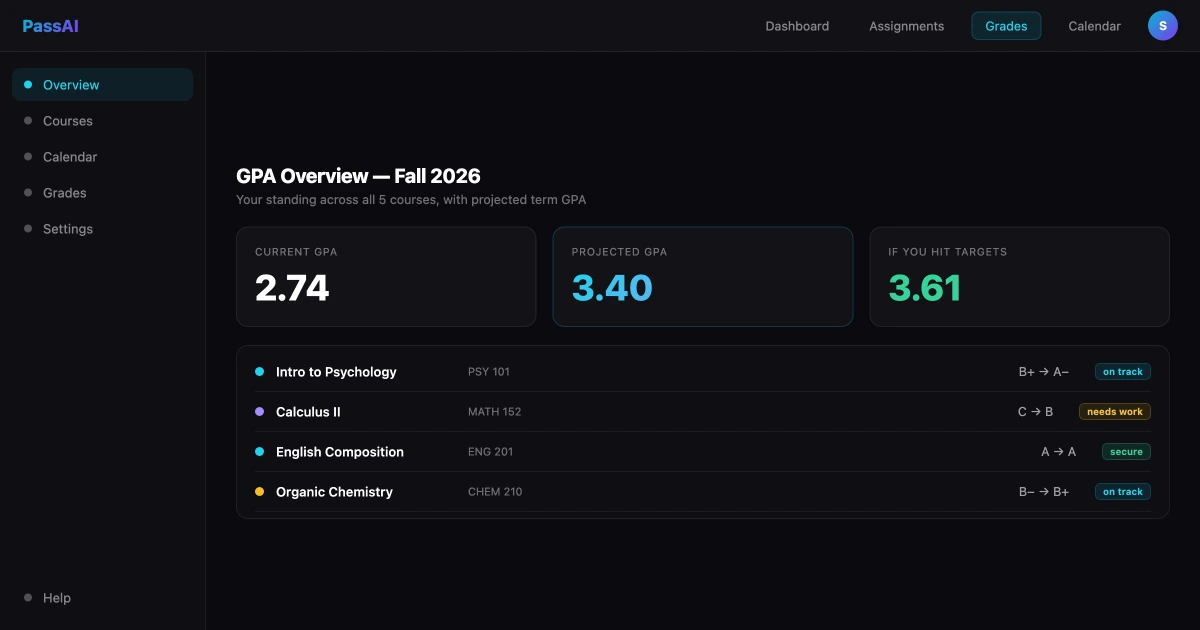
You upload each syllabus once, and PassAI extracts every assignment, exam, and grade weight automatically. As scores come back, you enter them and the grade calculator keeps a running, accurate current grade for every class. Set a target, and it shows the exact score you need on each remaining assignment — flagging the ones that have become impossible so you stop chasing them. Think of it as a college GPA calculator that doesn't stop at your current number: a standard GPA calculator tells you where you stand, while PassAI tells you the score you need going forward to get where you want to be.
On top of that sits the part that keeps a recovery alive day to day: a daily email telling you what's due and what to prioritize, so the easy points don't slip and the high-leverage work stays in front of you. Where a GPA calculator alone tells you the math, the daily plan makes sure you act on it.
If you're comparing options, our roundup of the best AI tools for college students covers where PassAI fits — but the short version is that it's the one built specifically around grade weights and the what-you-need math, which is exactly what a GPA recovery runs on.
Frequently Asked Questions
How can I improve my GPA in college when I'm already behind?
Start with the math, not motivation. For each class, calculate your current weighted grade and the score you need on remaining assignments to hit your target. Then put your time into the classes where improvement is both possible and high-impact — usually the ones with large ungraded items still ahead (finals, major papers, projects). A grade calculator like the one in PassAI does this automatically: enter your scores and target, and it shows exactly what you need on what's left.
How much can my GPA realistically go up in one semester?
It depends on how many credits you're taking and how much of your grade is still ungraded. A single strong semester can move a cumulative GPA by a few tenths, but the more credits already on your transcript, the slower the cumulative number moves. The fastest gains come within a single term: if 40–60% of each class is still ungraded — finals, final papers, projects — you have real room to move those individual grades. Use a grade calculator to see the realistic ceiling per class instead of guessing.
Does retaking a class replace the bad grade in my GPA?
At many colleges, yes — grade-replacement or grade-forgiveness policies let the new grade replace the old one in your GPA calculation rather than averaging the two. If a single low grade is dragging down your cumulative GPA, retaking that one course can move your number more than a full semester of new classes. The rules vary by school (how many times you can use it, which grades qualify, whether the original stays on your transcript), so check your registrar's policy before you plan around it.
Which assignments have the biggest impact on my GPA?
The ones with the highest grade weight that you haven't completed yet. A final exam worth 40% of your grade moves your class average far more than a homework set worth 3%, even though the homework feels more urgent because it's due sooner. Improving your GPA is mostly a prioritization problem: spend your hours where the grade weight is, not where the next due date is.
Is a 3.0 GPA good in college?
A 3.0 is a solid B average and is generally considered respectable. Many honors programs, scholarships, and competitive grad schools look for 3.5 or higher, and some employers screen at 3.0. But context matters — a 3.0 in a demanding major can carry more weight than a higher GPA in an easier one. The useful move isn't comparing yourself to a benchmark; it's figuring out the specific scores that get you to your own target and working backward from there.
Can a grade calculator actually help me raise my GPA?
Yes — because it converts a vague goal ('get my grades up') into specific, achievable numbers. Instead of studying anxiously and hoping, you see that you need, say, an 86% on your Biology final to finish with a B. That number tells you whether a target is realistic, how hard to push, and which classes deserve your remaining hours. PassAI's grade calculator does this for every class at once and is free to start at passai.pro.
PassAI tracks your real grade in every class and shows exactly what you need on what's left.
Free to start. No credit card required.